
If you are choosing a laboratory-grown diamond, including a memorial diamond made from ashes or hair, you will often be asked whether you want an IGI or a GIA report. The two laboratories now report on laboratory-grown diamonds in quite different ways. This guide explains what each report tells you, how to check one, and what no grading report can tell you.
The short answer
IGI (International Gemological Institute) reports carat weight, color and clarity, with cut grading where applicable. Since 1 October 2025, GIA (Gemological Institute of America) no longer gives colorless to near-colorless laboratory-grown diamonds individual color and clarity grades. Instead, its Laboratory-Grown Diamond Quality Assessment classifies qualifying diamonds as Premium or Standard. Some submissions receive neither classification. GIA issues separate reports for laboratory-grown colored diamonds.
Neither report is a better or worse “certificate” in general. They answer different questions. If you want to see the exact color and clarity grade of a colorless diamond, an IGI report shows it. If you want GIA’s overall quality classification, a GIA assessment gives you that instead. Whichever you choose, check the report with the laboratory that issued it.
What changed at GIA in October 2025
On 1 October 2025, GIA changed its reporting service for D-to-Z laboratory-grown diamonds to the Laboratory-Grown Diamond Quality Assessment. GIA explained that most laboratory-grown diamonds fall within a narrow range of color and clarity, so it no longer applies the grading terms it created for natural diamonds to them.
According to GIA’s announcement, the Laboratory-Grown Diamond Quality Assessment works like this:
- Premium requires D color, VVS clarity or better, Excellent polish and symmetry, and, for round brilliants, an Excellent cut grade.
- Standard applies when a diamond meets every minimum requirement but does not meet all Premium requirements: D to J color, VS clarity or better, at least Very Good polish, at least Very Good symmetry for round brilliants or Good symmetry for fancy shapes, and at least Very Good cut for round brilliants.
- Diamonds that do not meet the Standard criteria do not receive an assessment, and GIA charges an evaluation fee.
- The service is for loose diamonds of 0.15 carat or more. The girdle is laser inscribed with “Laboratory-Grown” and the GIA assessment number.
For example, a D-color diamond with VS clarity can qualify as Standard. Premium requires every Premium criterion to be met.
So a GIA assessment tells you which band a colorless or near-colorless diamond falls into. It does not tell you whether the diamond is, for example, F VS1 or H VS2.
GIA’s sample Quality Assessment includes a notice that laboratory-grown status was disclosed and that no additional testing was performed. Ask which identification and treatment checks are included in the service you are ordering.
Earlier GIA laboratory-grown diamond reports may show individual color and clarity grades. Check the document’s date and service name, and verify its record with GIA.
What an IGI laboratory-grown diamond report includes
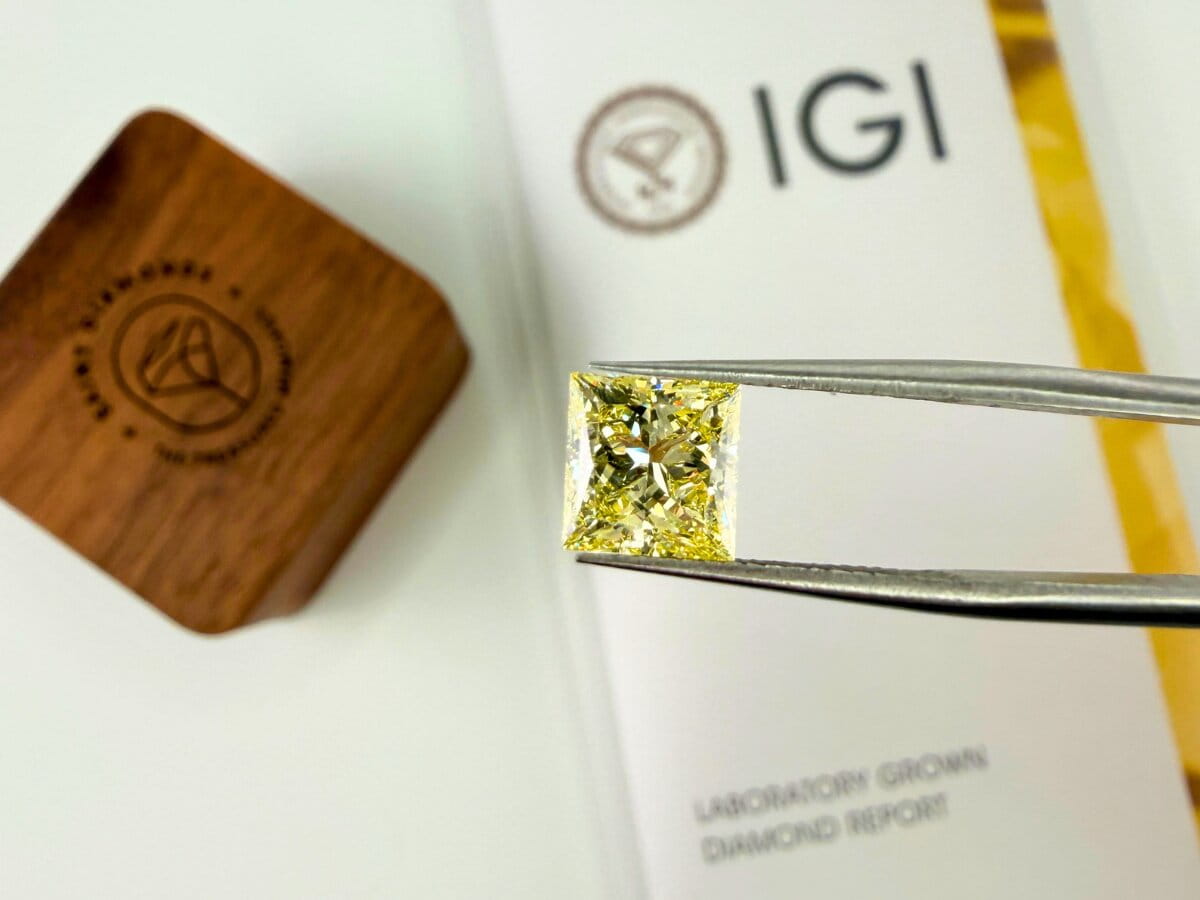
IGI continues to grade laboratory-grown diamonds in detail. According to IGI, its Laboratory Grown Diamond Report describes the shape, cutting style and measurements and gives 4Cs assessments. It may also include a proportions diagram and a plot of clarity characteristics.
IGI’s service page says growth-process and treatment comments can be provided on request. Its January 2021 announcement described “as grown with no indication of post-growth treatment” wording for untreated HPHT (high pressure, high temperature) and CVD (chemical vapor deposition) diamonds, and “may include post-growth treatment” wording for other CVD diamonds. Read the comments on the individual report, including any qualifications. IGI also offers laser inscription of the report number.
IGI’s guide How to Read an IGI Laboratory Grown Diamond Report shows a current sample with each section labelled.
IGI and GIA compared, question by question
Do you get a color and clarity grade?
IGI: Yes. The report gives a color grade and a clarity grade, alongside carat weight and, where applicable, cut.
GIA: Not for colorless to near-colorless laboratory-grown diamonds. You get a Premium or Standard classification. GIA’s Laboratory-Grown Colored Diamond Report covers colored diamonds and includes a full quality assessment and a plotted clarity diagram.
Is the growth method or treatment disclosed?
IGI: Check the comments on the specific report. IGI says growth-process and treatment information can be included on request; the wording may express uncertainty.
GIA: GIA’s colored laboratory-grown reports include an assessment of growth type and post-growth treatment.
Is the diamond inscribed?
IGI: IGI can laser inscribe the report number on the girdle.
GIA: Assessed and reported diamonds are inscribed with “Laboratory-Grown” and the GIA assessment or report number.
Can the diamond already be set in jewelry?
GIA: The GIA laboratory-grown services discussed here require loose diamonds weighing at least 0.15 carat. If your diamond is already set, ask your jeweler and GIA about submission options.
IGI: IGI also issues reports for laboratory-grown diamond jewelry. Shape, cutting style, measurements and 4Cs assessments for center stones are provided as the mounting permits. These reports have different limitations from reports on loose stones.
Can you check the report online?
Both. GIA reports can be checked with GIA Report Check. IGI reports can be checked with IGI’s Verify Your Report tool. The steps are below.
What about colored memorial diamonds?
Many memorial diamonds are not colorless. GIA’s Premium/Standard assessment covers colorless to near-colorless diamonds only. GIA offers separate services for laboratory-grown colored diamonds: a full Colored Diamond Report and a Color Identification report. Their scope differs, so confirm which service is suitable for the individual stone and what information it provides.
Some colors are created after the diamond has grown. At Saint Diamonds, colorless, blue, yellow and black are grown colors, while pink, red and green are treated colors created after growth. Ask how post-growth treatment is described in the report for your individual diamond, including any qualifications in the laboratory’s findings.
How to check a grading report
- Find the report number. It is printed on the report and, if the diamond is inscribed, on the diamond’s girdle.
- Look it up with the laboratory that issued it. Use GIA Report Check for a GIA document and IGI Verify Your Report for an IGI report. Use the laboratory’s own website rather than a link or QR code from an unknown source.
- Compare the details. The online record should match your document: the type of report, shape, measurements, carat weight and grades or classification.
- Match the diamond to the report. GIA notes that a laser inscription can be read with a jeweler’s loupe or microscope at 10x magnification. GIA has also warned that some stones have been found with copied report numbers, so ask a jeweler or gemologist to confirm that the stone itself matches the report, not just the paperwork.
Our guide on how to tell if a diamond is real explains why home tests are unreliable and when to involve a professional.
What a grading report does not tell you
The scope depends on the document and service. Do not assume every assessment includes the same identification or treatment checks. The IGI and GIA documents discussed here do not verify whose ashes or hair supplied the carbon for a memorial diamond.
Material provenance is a separate question. Ask the provider how your material is identified, tracked and used, what records are retained, and whether those procedures are independently checked. A grading result or report number does not establish that chain of custody.
A grading report is also not a monetary appraisal.
Certification at Saint Diamonds
- Every diamond comes with a Saint Diamonds certificate issued by us. This is separate from an independent laboratory report.
- An IGI grading report and a personal inscription are included for diamonds of 1 carat or larger. This package is optional for smaller diamonds.
- A GIA assessment or report is available on request, subject to the requirements of the selected service. Please ask before your diamond is set.
You can see what is included at each size on our memorial diamond prices page. For background on how color, clarity, cut and carat are judged, read our guide to the 4Cs.
Sources
- GIA, Updated Laboratory-Grown Diamond Services to Launch October 1: Premium and Standard criteria, size limit and inscription
- GIA, Laboratory-Grown Diamond Services: Quality Assessment and Laboratory-Grown Colored Diamond Reports
- GIA, Sample Laboratory-Grown Diamond Reports: current samples of each GIA laboratory-grown document
- IGI, Laboratory Grown Diamond Report: 4Cs, growth method, treatment disclosure and inscription
- IGI, How to Read an IGI Laboratory Grown Diamond Report: annotated sample report
- IGI, Lab-Grown Reports Now Indicate Treatments (January 2021): “as grown” and post-growth treatment comments
- GIA, Diamond Buying Tips: Report Check and reading a laser inscription
- GIA, GIA Counters Counterfeit Inscriptions (February 2021): stones carrying copied report numbers
All sources accessed 5 October 2026.